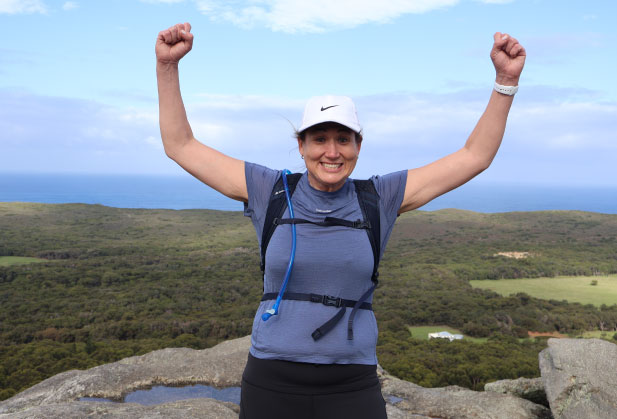
There is no single answer to “How hard is the Cape to Cape?” or “How fit do I need to be to walk it?” One hiker will love the long beach sections. Another will find soft sand the hardest part of the week. Some people move quickly over rocky ground; others are happiest taking their time. Fitness matters, but so do foot health, confidence, recovery, weather, previous walking experience and — more than most people expect — mindset.
That is exactly why Cape2Camp is built around a supported, self-guided experience. We want hikers to understand the real challenge, prepare well, and then have the freedom to walk at their own pace while we take care of the logistics around them.
First: what is the official grading?
The Cape to Cape Track is officially listed by Trails WA as Class 4 – Difficult, with the important qualification that the track is “moderate to difficult depending on section”. Trails WA describes Class 4 trails as having rough surfaces that may include very steep hills or extensive rock hopping, with directional signage that can be limited. Bushwalking experience, navigation and emergency first aid skills, and good fitness are recommended.
The national Australian Walking Track Grading System (AWTGS) uses five grades. The final grade is based on the most difficult of five criteria — experience required, steps, gradient, path quality and signage — rather than an average of the whole walk. That matters on a long trail like the Cape to Cape, because an overall Grade/Class 4 does not mean every kilometre feels like Grade 4 terrain.
Understanding the five official walking track grades
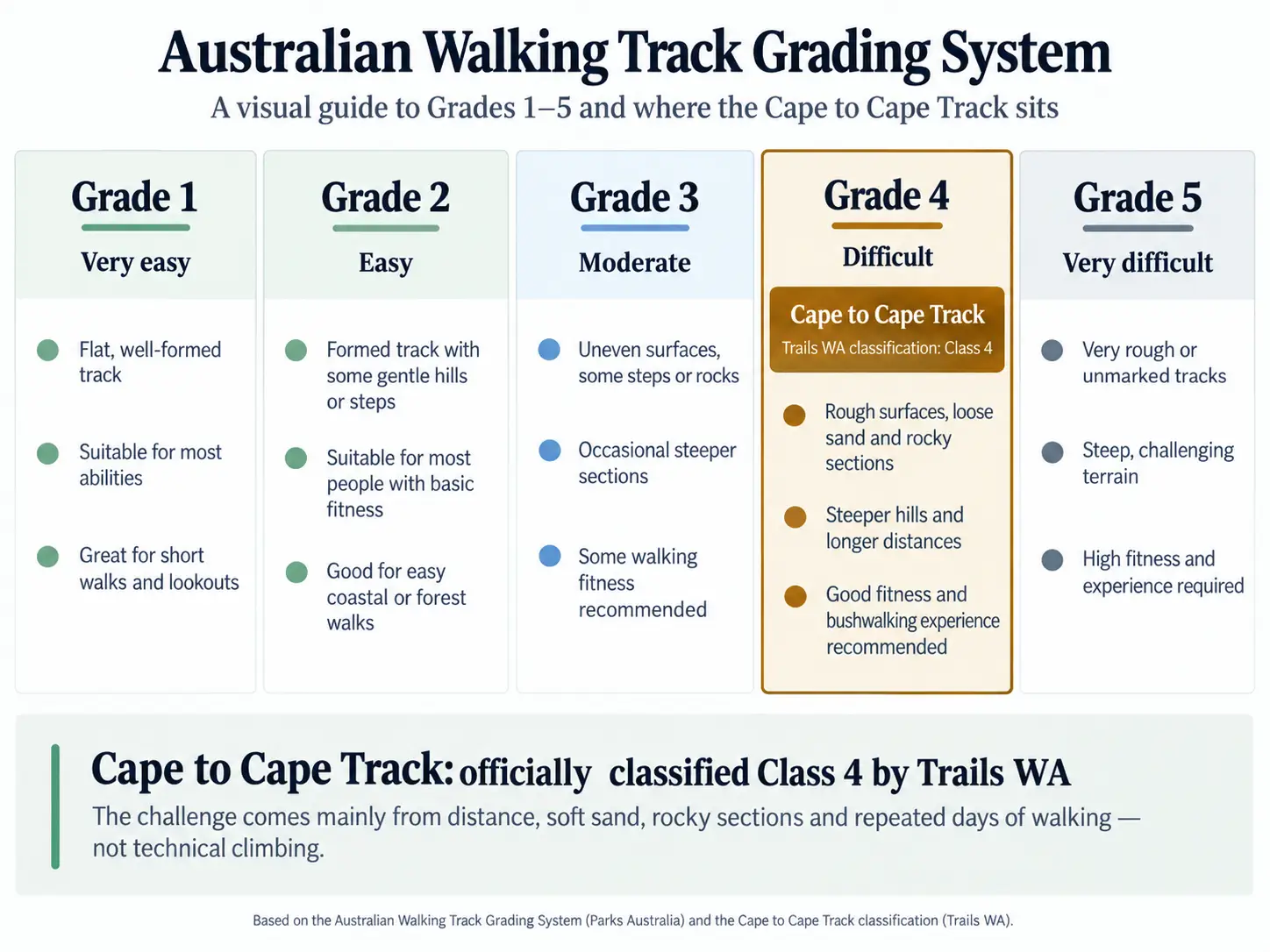
Official reference: Australian Walking Track Grading System (Parks Australia). Cape to Cape classification: Trails WA.
So what does Class 4 actually mean on the Cape to Cape?
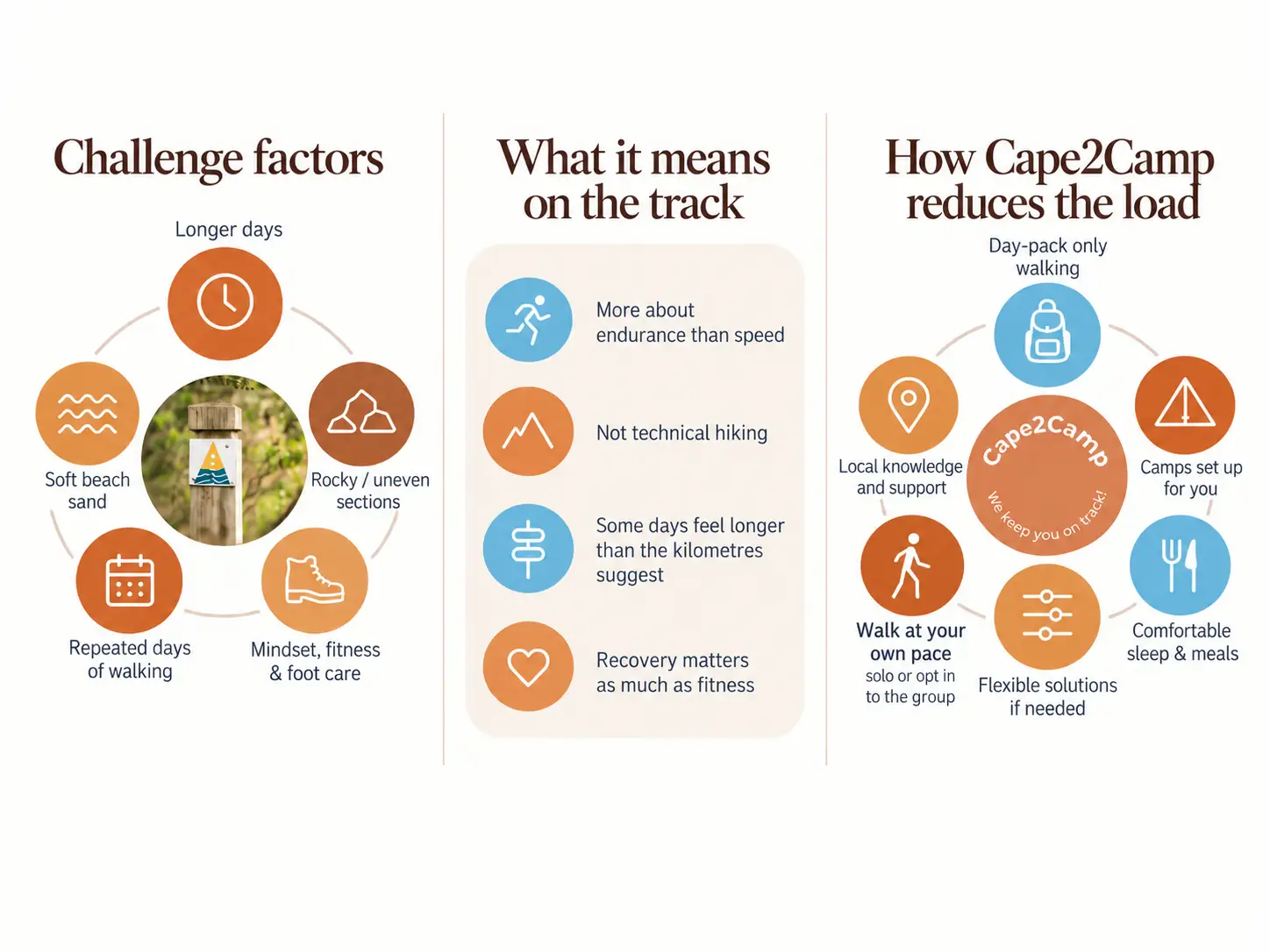
An overall Class 4 grading does not mean every kilometre is extreme terrain. Trails WA describes the Cape to Cape as a mix of 4WD tracks, constructed pathways, firm graded trails, rough stony paths and long stretches of soft sandy beach. There are easier sections, while some of the wilder sections are rugged and hard going.
It is also not a technical mountaineering hike. You are not learning rope skills or climbing exposed alpine routes. For most Cape2Camp hikers, the challenge is much more about endurance: consecutive days on your feet, long distances, soft sand, uneven coastal rock, stairs, hills, changing conditions and managing your body well over a full week.
How fit do I need to be to walk the Cape to Cape Track?
You do not need to be an elite athlete, but you do need a reasonable level of walking fitness for consecutive days on your feet. On Cape2Camp’s seven-day End-to-End, the main fitness demand is endurance rather than speed: being comfortable walking for several hours, recovering overnight and doing it again the next day, with the longest day around 26 km.
Preparation is less about walking fast and more about building time on your feet. Gradually increase your walking, include some longer walks and back-to-back walking days, and train in the footwear you plan to use. Because Cape2Camp transfers your luggage and takes care of camp setup and the main logistics, you can keep more of your energy for the walking itself.
Fitness is also only one part of the picture. Foot care, recovery, pacing, confidence, mindset and how you respond to sand and uneven ground can matter just as much. That is why two people with a similar fitness level can experience the same section very differently.
The Cape2Camp perspective: where the challenge really sits
Cape2Camp’s 7-day End-to-End: what each day looks like
Cape2Camp’s current 7-day End-to-End itinerary covers approximately 132 km from Cape Naturaliste to Cape Leeuwin. Daily section distances are approximate and can vary slightly with mapped access points, track changes and exactly where each day begins and finishes. For Cape2Camp guests, the practical guide is the day-by-day itinerary below.
| Day | Section | Distance | What to expect |
|---|---|---|---|
| 1 | Cape Naturaliste → Yallingup | 16 km | A beautiful introduction to the week: coastal views, Sugarloaf Rock and time to settle into your walking rhythm. |
| 2 | Yallingup → Moses Rock | 18 km | Smiths Beach, Injidup and coastal trail. Varied underfoot and a noticeable step up in time on your feet. |
| 3 | Moses Rock → Gracetown | 14 km | Wilyabrup coastline and rougher, more uneven sections. Shorter distance does not always mean an easier day. |
| 4 | Gracetown → Prevelly | 20 km | A longer day through Cowaramup Bay, Ellensbrook and the Margaret River Mouth. Cumulative fatigue can start to show. |
| 5 | Prevelly → Conto | 19 km | Boodjidup, Redgate, Bob’s Hollow and Contos. A mix of coast, rock and trail with a stronger wilderness feel. |
| 6 | Conto → Hamelin Bay | 22 km | Boranup Forest, coastline and beach walking. Beautiful and rewarding, but a substantial day. |
| 7 | Hamelin Bay → Cape Leeuwin | 26 km | The longest day: rugged coast, Cosy Corner, Deepdene Beach and the final push to Cape Leeuwin. |
Note: daily distances are approximate. The Cape2Camp End-to-End route is approximately 132 km overall, while individual day figures can vary slightly depending on mapping and access points.
The key point: the longest day is 26 km, and that comes after six previous days of walking. For many people, the “difficulty” of the Cape to Cape is not one huge climb — it is the accumulation of kilometres. That is also why pacing, recovery and foot care matter so much.
What we see again and again: mindset matters
Preparation matters, but mindset can change the entire experience. A 26 km day can feel overwhelming if you spend the morning thinking about the finish line. It can feel completely different if you break it into the next headland, the next swim, the next snack stop and the next beautiful view.
Some hikers love beach walking. Some absolutely do not. Some are naturally fast; others settle into a slower, steady rhythm. The important thing is not to let somebody else’s description of the track become your expectation. Everyone brings a different body, background and perception of challenge.
“After seeing so many different hikers come through Cape2Camp, I keep coming back to two things: mindset and connection. What has surprised me is how much it can help, even on a self-guided hike, to have people around you. Friends and people who have never met before can opt in and out of walking together — have a chat, encourage each other on a slower day, or simply find their own pace. That flexibility matters. You still get to walk your own way, but you don’t have to feel like you’re doing it alone.”
— Anne Nordgard, Founder, Cape2Camp
Why Cape2Camp was created: keep the challenge, remove the unnecessary load
Cape2Camp was not created to make the Cape to Cape “easy”. The challenge is part of the adventure. The idea is to remove the things that do not need to make it harder: a heavy multi-day pack, camp setup, luggage logistics, meal planning and the pressure to keep up with a guided group.
You walk light
Your hand luggage is transferred between camps, so you walk with a day pack rather than carrying your full camping setup, bedding and food.
Camp is ready
At the end of the day, your tent and bedding are waiting. Where campground facilities allow, you can shower, eat, stretch, relax and focus on recovery rather than building camp.
You set your own pace
Cape2Camp is self-guided. You can stop for a swim, take a long lunch, sit down to sort out your feet or simply slow down. If you need the whole day, you have the whole day.
Open group or private
Some hikers love the encouragement and camaraderie of joining an open departure. Others prefer to walk privately with a partner, family or friends. Both still allow you to walk in your own rhythm.
Support stays in the background
You are independent on the track, but not unsupported. Cape2Camp provides 24/7 phone support and a WhatsApp group, along with the practical systems that keep the experience moving from camp to camp.
Flexible solutions
Where vehicle access and operations allow, shorter walking days or additional pickups can often be arranged, with additional charges where applicable. If someone needs a rest day, we can look at practical options to help them rejoin the itinerary.
What about age?
Age can influence pace and recovery, but it is only one part of the picture. Previous injuries, balance, confidence, time on your feet, strength, foot health and how well you recover between days can be just as important. A birth date by itself is not a useful prediction of how somebody will experience a long-distance walk.
We have welcomed hikers across a very wide age range. We have also seen people with little or no previous hiking experience surprise themselves with what they can do. Our oldest hiker to date was 80 years old, and on our three-day Bibbulmun experience she completed the most challenging 27 km day in around seven hours.
That is one individual example, not a benchmark for anybody else, but it is a brilliant reminder that age alone does not define capability. The Cape2Camp format also removes some of the load that can matter over consecutive days: no heavy overnight pack, no camp setup or pack-down, and more energy available for walking and recovery.
If we could give one preparation tip: take foot care seriously
Blisters can stop a strong hiker faster than a lack of fitness. You can be well trained and still have a difficult week if a small hot spot on Day 2 becomes a significant blister by Day 4.
Before the hike: train in the footwear you plan to use, know which socks work for you, avoid relying on brand-new shoes for the trip, and learn how you will treat hot spots and blisters.
During the hike: stop early. If something is rubbing, burning or becoming uncomfortable, deal with it straight away. Five minutes spent on your feet early can save hours of discomfort later in the week.
What footwear do we recommend?
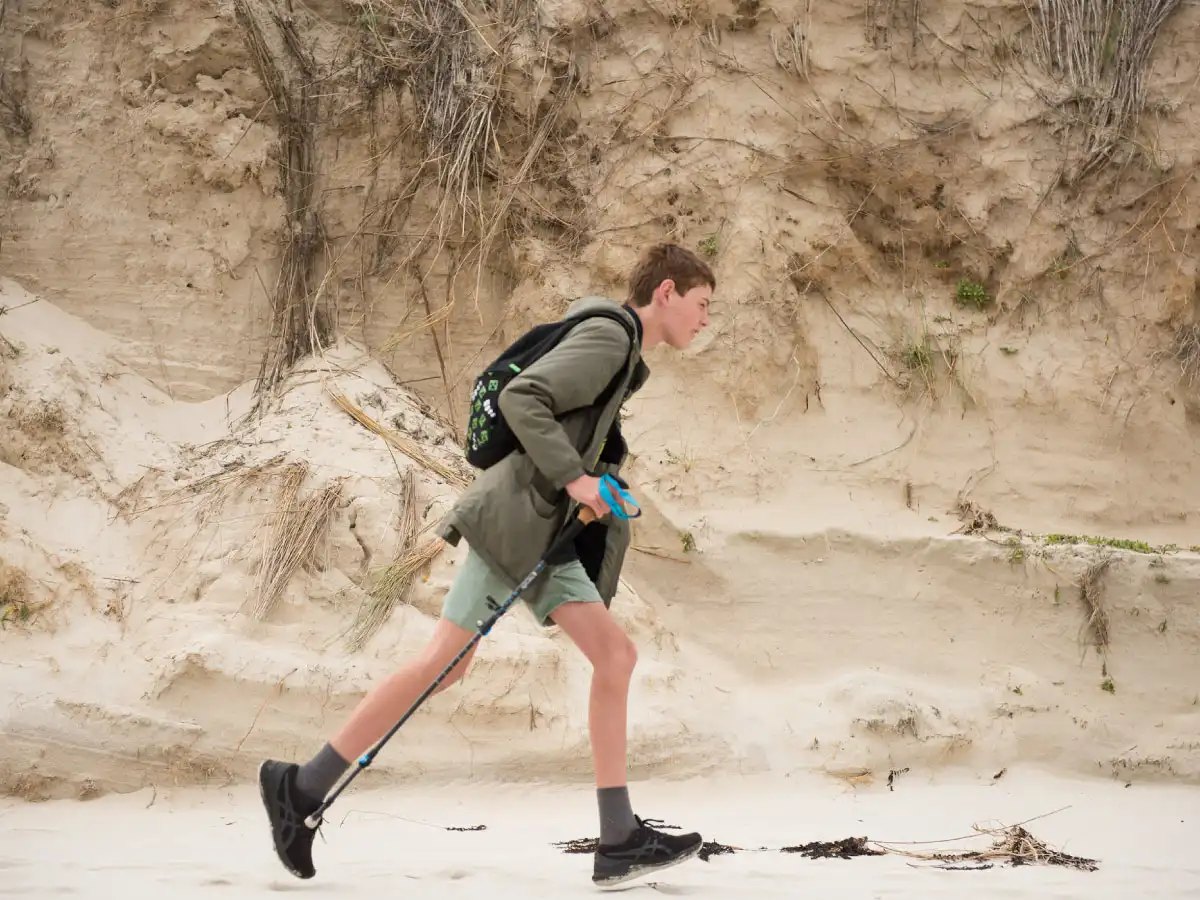
Anne’s personal take: for most Cape to Cape walkers, I would choose a lightweight, comfortable pair of trainers or trail shoes with good grip over a heavy, high-cut hiking boot. Much of the route is rolling coastal terrain rather than steep mountain walking, and comfort over repeated kilometres matters enormously. The best option is usually something your feet already know and that you have worn over distance.
I would be cautious about buying a brand-new, heavy hiking boot just because you are doing a multi-day walk. If you have ankle instability, existing foot or ankle issues, or have been advised to use more support, your needs may be different. The key is fit, comfort, grip and having tested your footwear well before Day 1.
Navigation and conditions: non-technical does not mean no preparation
The Cape to Cape is not a technical climbing route, but it is still a long-distance coastal bushwalk. Cape2Camp recommends downloading offline navigation before departure, including AllTrails Pro or the Cape to Cape Navigation App. Trails WA also recommends carrying appropriate navigation and not relying solely on a phone in remote areas.
Conditions can change. Coastal weather, beach conditions, track closures and water crossings can affect a walk, particularly in winter and spring. Because Cape2Camp is operating locally along the route, we also help hikers understand what changing conditions may actually mean for the section ahead and share practical updates where relevant. Hikers should still follow current track alerts and safety advice before and during the trip.
So, is the Cape to Cape hard?
Yes — it is a genuine long-distance walking challenge. It is officially Class 4, the days are long enough to demand preparation, and there are sections of soft sand, rough rock and rugged coastline. The final day of our seven-day itinerary is 26 km, which deserves respect.
But “challenging” and “unachievable” are not the same thing. Cape2Camp is designed to help hikers find that sweet spot: enough challenge to feel adventurous and proud, with enough support, flexibility and comfort to let the track itself remain the focus.
If the Cape to Cape has been sitting on your bucket list, prepare properly, look after your feet, give yourself time and do not let somebody else’s experience decide what yours will be. Walk your way. We will keep you on track — day and night.
7-Day End-to-End · 132 km
Explore the Cape2Camp 7-Day End-to-End experience — approximately 132 km, self-guided and fully supported.